
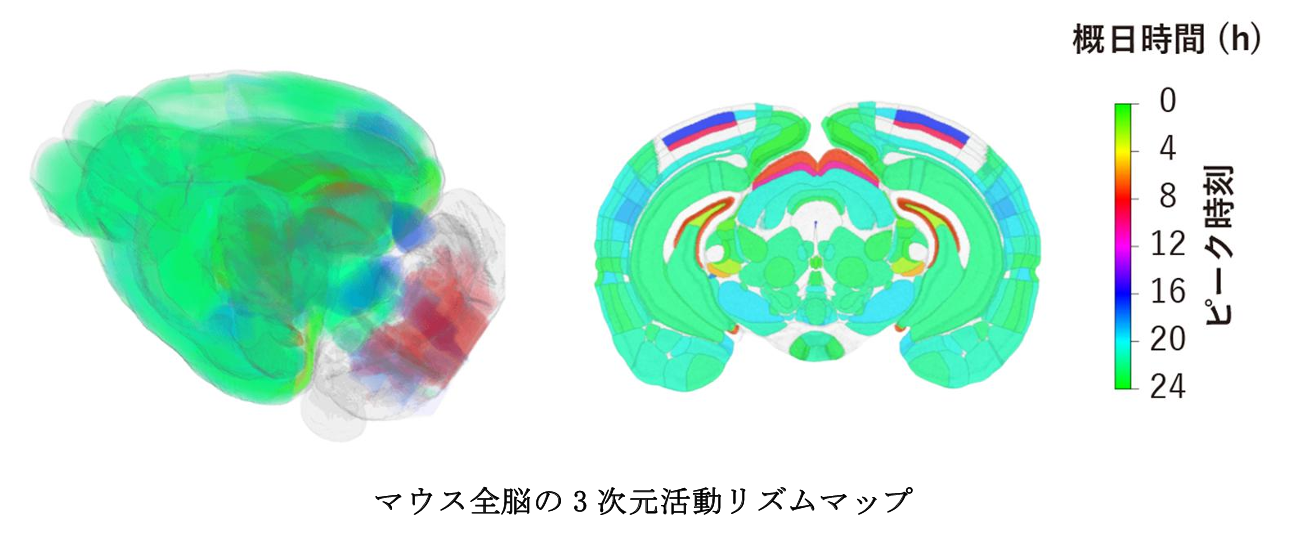
Whole‑brain activity rhythms visualized in 3D
— Revealing morning, daytime, and nighttime activity patterns across multiple mouse brain regions —
A research group led by Professor Yasushi Ueda (Graduate School of Medicine, The University of Tokyo; also Specially Appointed Professor at Kurume University), Mr. Katsunari Yamashita (Special Research Student, Graduate School of Medicine, Osaka University), Dr. Fukuaki Kinoshita (Project Researcher), and Associate Professor Michihiro Yamada (Institute of Molecular Life Science, Kurume University) has revealed that neural activity in multiple regions of the mouse brain exhibits daily rhythmic patterns.
In this study, by applying the tissue‑clearing technology “CUBIC (Note 1)” to observe whole‑brain neural activity from time‑series samples, the team demonstrated for the first time in the world that approximately 80% of brain regions show circadian activity rhythms. While previous studies were limited to specific brain areas, the present work comprehensively evaluated the entire brain through high‑precision time‑series analysis and released the results as a whole‑brain database on the web. These findings establish a new foundation for understanding brain activity from a temporal perspective and are expected to contribute to future studies of time‑dependent brain functions—such as sleep, memory, and drug efficacy—as well as to medical applications.
The results of this study were published online in the international scientific journal “Science” on November 13, 2025 (U.S. Eastern Time).
Reference:
A whole-brain single-cell atlas of circadian neural activity in mice,
【】
K. Yamashita, F. Kinoshita, et al., Science (2025).CUBICStars Inc.
Email: info@cubicstars.com
Web: https://www.cubicstars.com/
東京大学大学院医学系研究科の上田 泰己 教授(久留米大学 特別招聘教授 兼任)、山下 勝成 特別研究学生(大阪大学大学院医学系研究科 博士課程)、 木下 福章 特任研究員、久留米大学 分子生命科学研究所 山田 陸裕 准教授らの研究グループは、 マウス脳のさまざまな領域の神経活動が1日の中でリズムを示すことを明らかにしました。
本研究では、組織透明化技術「CUBIC(注1)」を用いて、時系列的に採取したマウス脳全体の神経活動を観察することで、 脳の約8割の領域で一日周期の活動リズムが見られることを世界で初めて明らかにしました。 従来の研究が限られた脳領域にとどまっていたのに対し、本研究では、高精度な時系列解析により脳全体を網羅的に評価し、 その結果を全脳データベースとしてWeb上に公開しました。この成果は、脳の活動を時間軸から理解するための新たな基盤となり、 今後、睡眠・記憶・薬効などの時間依存的な脳機能研究の発展や医療応用への貢献が期待されます。
本研究成果は、2025年11月13日(米国東部時間)に米国学術誌「Science」のオンライン版で公開されました。
Reference:
A whole-brain single-cell atlas of circadian neural activity in mice,
【】
K. Yamashita, F. Kinoshita, et al., Science (2025).CUBICStars Inc.
Email: info@cubicstars.com
Web: https://www.cubicstars.com/
由以下人员领导的研究团队 Professor Yasushi Ueda (Graduate School of Medicine, The University of Tokyo; also Specially Appointed Professor at Kurume University), Mr. Katsunari Yamashita (Special Research Student, Graduate School of Medicine, Osaka University), Dr. Fukuaki Kinoshita (Project Researcher), and Associate Professor Michihiro Yamada (Institute of Molecular Life Science, Kurume University) 揭示了小鼠大脑多个区域的神经活动呈现昼夜节律。
在本研究中, by applying the tissue‑clearing technology “CUBIC (Note 1)” to observe whole‑brain neural activity from time‑series samples, the team demonstrated for the first time in the world that approximately 80% of brain regions show circadian activity rhythms. While previous studies were limited to specific brain areas, the present work comprehensively evaluated the entire brain through high‑precision time‑series analysis and released the results as a whole‑brain database on the web. These findings establish a new foundation for understanding brain activity from a temporal perspective and are expected to contribute to future studies of time‑dependent brain functions—such as sleep, memory, and drug efficacy—as well as to medical applications.
本研究成果已于2025年11月13日(美国东部时间)在线发表在国际学术期刊《Science》。
Reference:
A whole-brain single-cell atlas of circadian neural activity in mice,
【】
K. Yamashita, F. Kinoshita, et al., Science (2025).CUBICStars Inc.
Email: info@cubicstars.com
Web: https://www.cubicstars.com/
A research group led by Professor Yasushi Ueda (Graduate School of Medicine, The University of Tokyo; also Specially Appointed Professor at Kurume University), Mr. Katsunari Yamashita (Special Research Student, Graduate School of Medicine, Osaka University), Dr. Fukuaki Kinoshita (Project Researcher), and Associate Professor Michihiro Yamada (Institute of Molecular Life Science, Kurume University) 마우스 뇌 여러 영역의 신경 활동이 일주기 리듬을 보인다는 사실을 규명했습니다.
In this study, by applying the tissue‑clearing technology “CUBIC (Note 1)” to observe whole‑brain neural activity from time‑series samples, the team demonstrated for the first time in the world that approximately 80% of brain regions show circadian activity rhythms. While previous studies were limited to specific brain areas, the present work comprehensively evaluated the entire brain through high‑precision time‑series analysis and released the results as a whole‑brain database on the web. These findings establish a new foundation for understanding brain activity from a temporal perspective and are expected to contribute to future studies of time‑dependent brain functions—such as sleep, memory, and drug efficacy—as well as to medical applications.
본 연구 성과는 2025년 11월 13일(미국 동부 시간)에 국제 학술지 Science 온라인판에 게재되었습니다.
Reference:
A whole-brain single-cell atlas of circadian neural activity in mice,
【】
K. Yamashita, F. Kinoshita, et al., Science (2025).CUBICStars Inc.
Email: info@cubicstars.com
Web: https://www.cubicstars.com/
A research group led by Professor Yasushi Ueda (Graduate School of Medicine, The University of Tokyo; also Specially Appointed Professor at Kurume University), Mr. Katsunari Yamashita (Special Research Student, Graduate School of Medicine, Osaka University), Dr. Fukuaki Kinoshita (Project Researcher), and Associate Professor Michihiro Yamada (Institute of Molecular Life Science, Kurume University) a révélé que l’activité neuronale de nombreuses régions du cerveau de la souris présente des rythmes circadiens.
In this study, by applying the tissue‑clearing technology “CUBIC (Note 1)” to observe whole‑brain neural activity from time‑series samples, the team demonstrated for the first time in the world that approximately 80% of brain regions show circadian activity rhythms. While previous studies were limited to specific brain areas, the present work comprehensively evaluated the entire brain through high‑precision time‑series analysis and released the results as a whole‑brain database on the web. These findings establish a new foundation for understanding brain activity from a temporal perspective and are expected to contribute to future studies of time‑dependent brain functions—such as sleep, memory, and drug efficacy—as well as to medical applications.
Les résultats ont été publiés en ligne dans la revue scientifique internationale Science le 13 novembre 2025 (heure de l’Est des États‑Unis).
Reference:
A whole-brain single-cell atlas of circadian neural activity in mice,
【】
K. Yamashita, F. Kinoshita, et al., Science (2025).CUBICStars Inc.
Email: info@cubicstars.com
Web: https://www.cubicstars.com/
A research group led by Professor Yasushi Ueda (Graduate School of Medicine, The University of Tokyo; also Specially Appointed Professor at Kurume University), Mr. Katsunari Yamashita (Special Research Student, Graduate School of Medicine, Osaka University), Dr. Fukuaki Kinoshita (Project Researcher), and Associate Professor Michihiro Yamada (Institute of Molecular Life Science, Kurume University) zeigte, dass die neuronale Aktivität in zahlreichen Regionen des Mausgehirns tagesrhythmische Muster aufweist.
In this study, by applying the tissue‑clearing technology “CUBIC (Note 1)” to observe whole‑brain neural activity from time‑series samples, the team demonstrated for the first time in the world that approximately 80% of brain regions show circadian activity rhythms. While previous studies were limited to specific brain areas, the present work comprehensively evaluated the entire brain through high‑precision time‑series analysis and released the results as a whole‑brain database on the web. These findings establish a new foundation for understanding brain activity from a temporal perspective and are expected to contribute to future studies of time‑dependent brain functions—such as sleep, memory, and drug efficacy—as well as to medical applications.
Die Ergebnisse wurden am 13. November 2025 (US‑Ostküstenzeit) online in der internationalen Fachzeitschrift Science veröffentlicht.
Reference:
A whole-brain single-cell atlas of circadian neural activity in mice,
【】
K. Yamashita, F. Kinoshita, et al., Science (2025).CUBICStars Inc.
Email: info@cubicstars.com
Web: https://www.cubicstars.com/
A research group led by Professor Yasushi Ueda (Graduate School of Medicine, The University of Tokyo; also Specially Appointed Professor at Kurume University), Mr. Katsunari Yamashita (Special Research Student, Graduate School of Medicine, Osaka University), Dr. Fukuaki Kinoshita (Project Researcher), and Associate Professor Michihiro Yamada (Institute of Molecular Life Science, Kurume University) reveló que la actividad neuronal en múltiples regiones del cerebro del ratón presenta ritmos diarios.
In this study, by applying the tissue‑clearing technology “CUBIC (Note 1)” to observe whole‑brain neural activity from time‑series samples, the team demonstrated for the first time in the world that approximately 80% of brain regions show circadian activity rhythms. While previous studies were limited to specific brain areas, the present work comprehensively evaluated the entire brain through high‑precision time‑series analysis and released the results as a whole‑brain database on the web. These findings establish a new foundation for understanding brain activity from a temporal perspective and are expected to contribute to future studies of time‑dependent brain functions—such as sleep, memory, and drug efficacy—as well as to medical applications.
Los resultados se publicaron en línea en la revista científica internacional Science el 13 de noviembre de 2025 (hora del este de EE. UU.).
Reference:
A whole-brain single-cell atlas of circadian neural activity in mice,
【】
K. Yamashita, F. Kinoshita, et al., Science (2025).CUBICStars Inc.
Email: info@cubicstars.com
Web: https://www.cubicstars.com/
A research group led by Professor Yasushi Ueda (Graduate School of Medicine, The University of Tokyo; also Specially Appointed Professor at Kurume University), Mr. Katsunari Yamashita (Special Research Student, Graduate School of Medicine, Osaka University), Dr. Fukuaki Kinoshita (Project Researcher), and Associate Professor Michihiro Yamada (Institute of Molecular Life Science, Kurume University) показала, что нейронная активность во многих областях мозга мыши подчиняется суточным ритмам.
In this study, by applying the tissue‑clearing technology “CUBIC (Note 1)” to observe whole‑brain neural activity from time‑series samples, the team demonstrated for the first time in the world that approximately 80% of brain regions show circadian activity rhythms. While previous studies were limited to specific brain areas, the present work comprehensively evaluated the entire brain through high‑precision time‑series analysis and released the results as a whole‑brain database on the web. These findings establish a new foundation for understanding brain activity from a temporal perspective and are expected to contribute to future studies of time‑dependent brain functions—such as sleep, memory, and drug efficacy—as well as to medical applications.
Результаты исследования были опубликованы в онлайн‑версии международного научного журнала Science 13 ноября 2025 года (восточное время США).
Reference:
A whole-brain single-cell atlas of circadian neural activity in mice,
【】
K. Yamashita, F. Kinoshita, et al., Science (2025).CUBICStars Inc.
Email: info@cubicstars.com
Web: https://www.cubicstars.com/